Quick answer
Dario Amodei owns essentially one company: Anthropic, the AI safety and research company he co-founded in February 2021, where he serves as CEO and holds roughly 1.6–1.8%. There is no portfolio of side companies, no family office empire, no chain of startups — just a single, extraordinarily valuable equity position in the company behind the Claude AI models.
That single position is currently valued at a $965 billion private valuation (Series H, May 2026), with an IPO reportedly targeting above $2 trillion. Understanding Amodei's "companies" therefore means understanding one company deeply: its unusual structure, its products, its backers, and the governance designed to keep its founders in control.
Anthropic: the company
Anthropic is an AI safety and research company founded in February 2021 by Dario Amodei, his sister Daniela, and five former OpenAI colleagues: Jack Clark, Jared Kaplan, Sam McCandlish, Tom Brown, and Christopher Olah. It is legally a Public Benefit Corporation (PBC) — a corporate form that binds it to consider public benefit alongside shareholder returns, a deliberate choice reflecting the founders' safety-first thesis.
The company builds the Claude family of AI models, positioned as the most capable and safety-conscious alternative to OpenAI's ChatGPT. By May 2026, Anthropic served 500+ business customers each spending over $1 million annually, counted eight of the Fortune 10 as customers, and had grown Claude Code's run-rate revenue past $2.5 billion. Total run-rate revenue crossed $47 billion — up from $14 billion just three months earlier.
The financials revealed in the September 2026 IPO prospectus show the cost of that growth: $4.6 billion in 2025 revenue (12x year-over-year) against a $42 billion net loss and $518 billion in planned cloud and infrastructure commitments, roughly 80% of it binding. Anthropic is simultaneously one of the fastest-growing and most capital-intensive companies ever built.
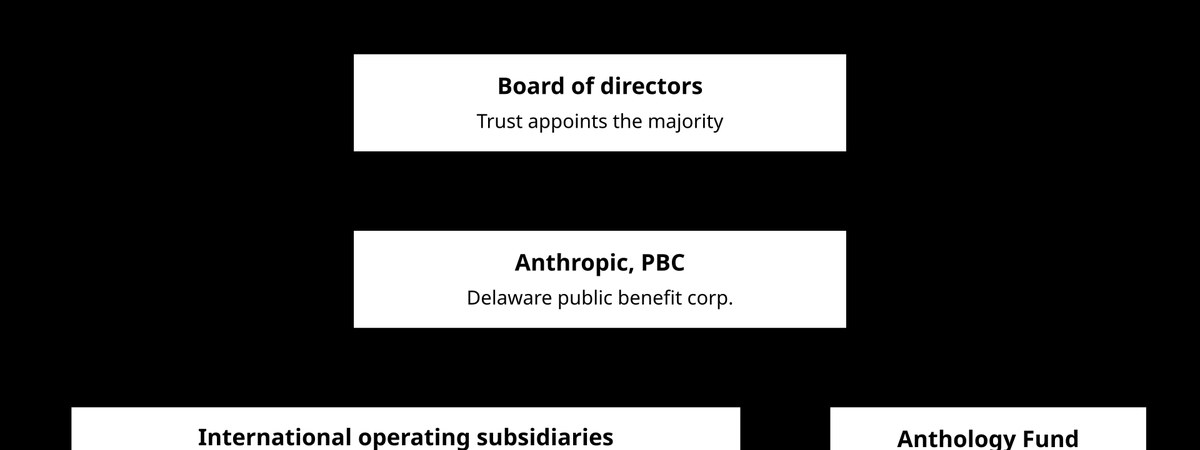
The unusual structure: PBC, Founder LLC, Class F shares
Anthropic's corporate architecture is as distinctive as its valuation. Three layers matter:
1. Public Benefit Corporation. Unlike a standard C-corp, Anthropic's charter requires directors to weigh public benefit — specifically AI safety — in decisions. This was a founding commitment, not marketing: the Amodeis left OpenAI over the tension between commercial speed and safety, and encoded the priority into the corporate form.
2. Founder LLC with 50.1% voting power. The seven co-founders collectively control a majority of votes through Class F shares held in a Founder LLC — a structure explicitly designed to persist until two or fewer founders remain. Even after an IPO dilutes their economic ownership well below 50%, they will retain control of the company's direction.
3. The Long-Term Benefit Trust (legacy). Anthropic's original governance included an independent trust meant to steward the mission; the Founder LLC structure reported in the IPO prospectus represents its evolution as the company scaled toward public markets.
For Amodei personally, the structure means his ~1.7% economic stake comes with outsized governance power — he is not just a large shareholder but a member of the control group that will steer a potential $2 trillion public company.
What Anthropic sells: Claude and the enterprise machine
Anthropic's revenue comes from selling access to intelligence in three forms:
| Product | What it is | Scale (2026) |
|---|---|---|
| Claude (consumer) | Subscription chatbot, ChatGPT competitor | Millions of subscribers |
| Claude for Enterprise | Business plans, 8 of Fortune 10 | 500+ customers at $1M+/yr |
| API & Claude Code | Developer access, agentic coding | $2.5B+ run-rate (Code alone) |
| Cloud partnerships | Via AWS, Google Cloud, Azure | Distribution at hyperscale |
The enterprise flywheel is the story: companies adopt Claude for customer service, coding, and analysis; usage compounds; Anthropic reinvests in compute; models improve; more enterprises sign on. The $47 billion run-rate suggests the flywheel is spinning — the $518 billion in infrastructure commitments shows what it costs to keep it spinning.
Claude vs ChatGPT: the product war
Anthropic's valuation rests on a single product bet: that Claude can take enterprise market share from OpenAI's ChatGPT by being more capable, more reliable, and more safety-conscious. By 2026, the bet was paying off — Claude had become the default choice for coding (via Claude Code), customer service, and regulated industries where OpenAI's reputation for moving fast reads as a liability.
The competitive dynamics favor Anthropic's positioning. Enterprises choosing an AI vendor in 2026 weigh not just benchmark scores but trust: data handling, safety record, and the vendor's public stance on AI risk. Amodei's years of writing about AI dangers — once seen as eccentric — became a commercial asset when Fortune 500 legal departments started asking hard questions.
OpenAI still leads in consumer mindshare and is reportedly seeking a $1.5 trillion valuation. But in the enterprise segment that drives Anthropic's $47 billion run-rate, Claude's safety-first branding is not just philosophy — it is product differentiation, and the market is pricing it at nearly a trillion dollars.
The backers: who owns pieces of Anthropic
Amodei's ~1.7% sits alongside some of the deepest pockets in technology. Major Anthropic stakeholders include:
Amazon — the most entangled partner: billions in total investment including $5 billion committed in the Series H, plus AWS as core infrastructure. Google — early investor and cloud partner. Microsoft — joined the cap table despite being OpenAI's primary backer, a hedge both ways. Nvidia — chips plus capital. Traditional venture: Sequoia, Altimeter, Dragoneer, Greenoaks, Coatue. Sovereign and strategic: GIC (Singapore), Gulf funds via QIA, and infrastructure partners Micron, Samsung, SK hynix.
The cap table reads like a map of the AI wars: cloud hyperscalers, chipmakers, sovereign wealth, and top-tier VC — all betting that Anthropic, not just OpenAI, defines the frontier. Amodei's founding stake, held since 2021, sits senior to all of it in provenance if not in size.
Why one company, not six
Contrast Amodei with the portfolio founders: Elon Musk runs six companies; Jeff Bezos spans Amazon stock, Blue Origin, and the Washington Post. Amodei has no known operating companies beyond Anthropic — no side startups, no investment firm, no public angel portfolio.
This is partly structural (he spent his pre-Anthropic decade as a salaried researcher, accumulating expertise rather than capital) and partly philosophical. His public writing argues that frontier AI is the highest-leverage problem in the world; splitting attention across companies would contradict the thesis. The 80% giving pledge reinforces it: the fortune is a means to fund safe AI development and philanthropy, not to build an empire.
For the value of that single stake and how he earned it, the companies story and the money story are the same story — which is precisely what makes it unusual.
IPO: what going public changes
The reported October 2026 Nasdaq listing — targeting above $2 trillion — would transform Anthropic from the world's most valuable private AI company into one of the world's most valuable public companies, period. For Amodei's holdings, three things change:
Liquidity: his stake becomes sellable (subject to lockups), converting paper billions into accessible wealth for the first time. Valuation reality-check: the Forbes-vs-Bloomberg $8B–$15.5B debate resolves into a single market price. Control test: the Founder LLC structure faces its first real stress — public shareholders, quarterly earnings, and the $518B in commitments, all under market scrutiny.
Reuters noted the debut could slip past the November midterms. Whenever it lands, it will be the largest listing in history — and the moment Amodei's one-company fortune meets the public market.
Frequently asked questions
What companies does Dario Amodei own?
Essentially one: Anthropic, where he holds roughly 1.6–1.8% as co-founder and CEO. Unlike Elon Musk's six-company empire, Amodei has no known stakes in other operating companies — his entire business footprint is Anthropic.
What is Anthropic worth in 2026?
Anthropic's Series H in May 2026 set a $965 billion private valuation — the largest private AI financing in history at $65 billion raised. Reuters reported its IPO prospectus targets above $2 trillion.
What does Anthropic sell?
Access to the Claude family of AI models: consumer subscriptions, enterprise plans, and API access for developers, offered directly and through Amazon, Google, and Microsoft cloud platforms. Run-rate revenue crossed $47 billion in May 2026.
Who are Anthropic's biggest investors?
Amazon (including $5 billion in the Series H), Google, Microsoft, Nvidia, Sequoia Capital, Altimeter, Dragoneer, Greenoaks, Coatue, and GIC. Strategic infrastructure partners include Micron, Samsung, and SK hynix.
What is the Founder LLC?
A governance structure giving Anthropic's seven co-founders 50.1% voting control through Class F shares — designed to persist until two or fewer founders remain, so the founders keep control long after an IPO dilutes their economics.
Sources
- AnthropicAnthropic
- Forbes — Dario Amodei ProfileForbes