
Quick answer
Josh Kushner made his money the old-fashioned venture way — then scaled it into an empire. He founded Thrive Capital in 2009 as a Harvard student, backed Instagram, Spotify, Stripe, OpenAI and SpaceX early, and rode those bets into a firm now managing more than $65 billion. His personal fortune: $17.5B, per the Bloomberg Billionaires Index (October 2026). The formula was patience — buy early, hold through the compounding, and take a manager's share of the profits via more than $6 billion in carried interest since 2010.
Unlike many billionaires, he did not inherit the core of it. His father Charles Kushner built a real estate fortune, but Josh built his own in venture capital — a deliberate separation from the family business. This is the story of the $17.5 billion fortune, step by step: the student startups, the Goldman detour, the bets that paid 100x, and the 2026 deal spree that made him a household name.
The Harvard years: Scene, Vostu and a $10,000 startup
Kushner arrived at Harvard College with an operator's instincts. In his second year he became founding executive editor of Scene, a student pop-culture publication. In his junior year he teamed with two graduate students to pool $10,000 and found Vostu, a social network aimed at Latin America as a Facebook alternative. After graduation he started Unithrive, a peer-to-peer student lending platform inspired by Kiva that matched alumni lenders with cash-strapped students.
Vostu later scaled back sharply after a copyright lawsuit from a competitor accused it of copying games, and laid off most employees in 2013 — an early lesson in how quickly software fortunes can reverse. But the pattern was set: start things early, learn fast, keep moving. He graduated from Harvard College in 2008, then spent a year in the private equity arm of Goldman Sachs working on distressed debt — a crash course in buying assets cheap — before returning for Harvard Business School (class of 2011).
2009: Thrive Capital is born
Kushner founded Thrive Capital in 2009 — while still a student — and has run it as managing partner ever since. The early fund wrote small checks into consumer internet at exactly the right moment. Thrive was an early investor in Instagram before Facebook bought it for $1 billion, backed Spotify and Stripe in their growth years, and established a reputation for spotting consumer and fintech winners before the crowd.
For a decade Thrive was a respected mid-size VC. Then the last three years detonated: assets under management went from about $15 billion to more than $65 billion, with more than half of that growth coming from investment gains rather than new fundraising, per Kushner's August investor letter. Bloomberg now values the firm itself at roughly $23 billion — and Kushner's ownership of that enterprise value is the single biggest line in his $17.5 billion net worth.
The two bets that changed everything: OpenAI and SpaceX
Every great VC fortune has a signature bet; Kushner has two. Thrive was an early investor in OpenAI, a position that has compounded enormously as AI valuations exploded — the firm participated in OpenAI's March 2026 round, which closed with $122 billion in committed capital at a $852 billion post-money valuation. And Thrive backed SpaceX early, then watched the company's $1.77 trillion IPO in June 2026 — the largest public offering in history — reprice the entire portfolio.

The supporting cast is strong too: an investment in AI coding company Cursor before SpaceX acquired it at a $60 billion valuation, stakes in Stripe and Anduril, and recent public-market moves into Amazon and Shopify. The portfolio's shape tells the story of 2010–2026 tech: social, payments, AI, space, then public equities.
The $6 billion engine: carried interest
The least glamorous and most lucrative part of the story is carried interest — the manager's share of investment profits. Bloomberg estimates Thrive has generated more than $6 billion in carried interest since 2010, with most of it earned in the last three years as the portfolio's winners compounded. As founder and managing partner, Kushner's share of that flow is a core pillar of his fortune.
| Wealth driver | Scale | Period |
|---|---|---|
| Thrive Capital enterprise value | ~$23 billion | Bloomberg est., Oct 2026 |
| Carried interest (firm-wide) | >$6 billion | Since 2010 |
| AUM growth | ~$15B → >$65B | Last 3 years |
| Share from investment gains | >50% of AUM | Per Aug investor letter |
This is how venture fortunes actually work: the management company itself becomes the asset. At ~$23 billion in enterprise value, Thrive is worth more than many public companies — and its founder owns the biggest piece.
The second act: Oscar Health and Cadre
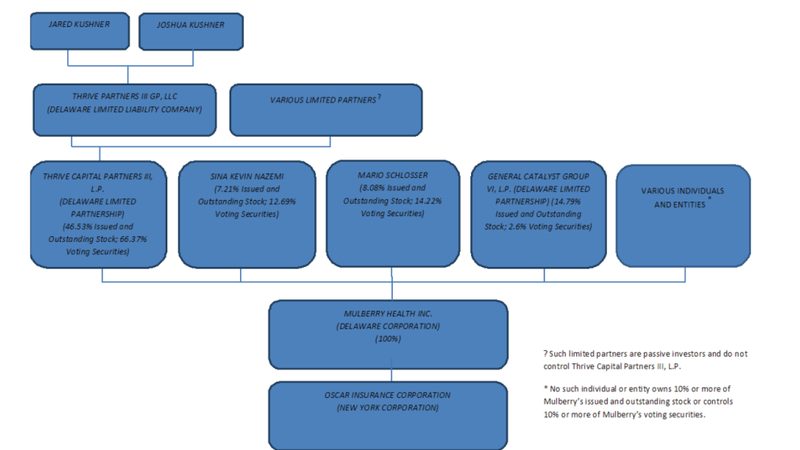
Kushner never put all his chips on Thrive. He co-founded Oscar Health, the technology-driven health insurer, where he remains vice-chairman; co-founded real estate investment platform Cadre; and co-founded Vostu back in 2006. Oscar in particular gave him a second operating identity beyond "VC" — a health-tech founder with a public-company track record.
For the full company-by-company breakdown, see Josh Kushner's companies.
The August letter: more than half the growth came from gains
In August 2026, Kushner did something unusual for a famously private investor: he wrote his investors a letter explaining the machine. The headline number: more than half of Thrive's assets under management now comes from investment gains, not from raising new funds. In an industry where most firms grow by marketing the next fund, Thrive grew by compounding the winners it already held — the $17.5B fortune is, in large part, the founder's share of that compounding.
The letter also framed the firm's evolution. Thrive no longer describes itself as just a venture fund: it is a public-markets investor (Amazon, Shopify), an owner of operating businesses (Thrive Holdings' 70-plus companies), and a holder of trophy assets (Thrive Eternal's Lakers and Giants stakes). Each expansion reuses the same core skill — spotting undervalued compounding machines early — in a new asset class. It is the clearest statement of intent Kushner has ever made: Thrive is being built to outlast the venture cycle, and his wealth is designed to compound with it.
2026: Thrive Eternal and the sports empire
The newest chapter is Thrive Eternal, a strategy for assets Kushner believes hold or grow their value as AI reshapes the economy: long-duration trophy assets. It financed the record $12.5 billion Los Angeles Lakers acquisition with Bob Iger in August 2026 and holds a minority stake in baseball's San Francisco Giants. A proposed FIFA investment collapsed within days after opposition from regional football groups. Separately, Thrive Holdings has raised more than $2 billion and acquired 70-plus companies in accounting, IT services and other sectors, aiming to transform them with AI.
The sports moves did something the VC returns never did: they made Kushner famous. Bloomberg noted his "long cultivated, under-the-radar profile" — the Lakers deal and the top-500 debut ended it.
The playbook: buy early, hold forever
Kushner's method is legible in hindsight. Buy early (Instagram pre-Facebook, OpenAI pre-boom, SpaceX pre-IPO). Hold through compounding — Thrive Eternal's entire premise is refusing to sell trophy assets. Expand the mandate — from startups to public equities to operating businesses to sports. And let the management company compound: at $65 billion in AUM, the fee and carry streams alone mint billionaires.
At 41, with income flowing from one of the richest carry streams in venture, he is not cashing out — he is buying basketball teams. The fortune's trajectory suggests the $17.5 billion is a waypoint, not a destination.
Frequently asked questions
How did Josh Kushner make his money?
Kushner founded Thrive Capital in 2009 and built it into a venture firm managing more than $65 billion. Early investments in Instagram, Spotify, Stripe, OpenAI and SpaceX compounded into a fortune Bloomberg pegs at $17.5 billion as of October 2026.
When did Josh Kushner start Thrive Capital?
He founded Thrive Capital in 2009 while still a Harvard student, after a year in Goldman Sachs' private equity arm working on distressed debt. He has run the firm as managing partner ever since, expanding it from startups into public markets, operating businesses and sports assets.
What companies did Thrive Capital invest in early?
Thrive's early winners include Instagram (before its $1 billion Facebook sale), Spotify, Stripe, OpenAI and SpaceX. It also backed AI coding company Cursor before SpaceX acquired it at a $60 billion valuation, and more recently bought into public companies Amazon and Shopify.
What is carried interest and how much has Kushner earned from it?
Carried interest is the firm's share of investment profits — typically around 20% above a hurdle. Bloomberg estimates Thrive has generated more than $6 billion in carried interest since 2010, most of it in the last three years, and Kushner's share of it is a core driver of his $17.5 billion fortune.
Did Josh Kushner inherit his wealth?
No. His father, Charles Kushner, built a real estate fortune, but Josh charted his own course in venture capital and health tech. He started Thrive as a student and grew it through early tech bets — the family real estate business went to his older brother Jared's orbit, not his.
Is Josh Kushner married?
Yes — he married model and entrepreneur Karlie Kloss in 2018, and they have three children. The couple keeps their family life largely out of the public eye.
How old is Josh Kushner in 2026?
He is 41 years old. Josh Kushner was born June 12, 1985, in Livingston, New Jersey, and graduated from Harvard College in 2008 and Harvard Business School in 2011.
Who is Josh Kushner's brother?
His older brother is Jared Kushner, the real estate investor and former senior White House adviser who is married to Ivanka Trump. Josh built his career separately from Jared and the family real estate business.