Quick answer
Jeff Bezos made his money the classic founder way: he started a company, kept a huge slice of it, and never sold the core position. In 1994 he quit a senior Wall Street job, took $245,573 from his parents, and launched an online bookstore from a Bellevue garage. Amazon's May 1997 IPO priced at $18 a share; after four stock splits, one IPO share became 240.
He survived the dot-com crash that erased 94% of Amazon's value, then built AWS — the cloud business that now produces the majority of Amazon's operating profit. Today his ~8.8% Amazon stake (about 879 million shares) is worth roughly $219 billion, anchoring a $378 billion fortune that also includes Blue Origin, valued at around $130 billion in 2026.
The garage years (1994–1997)
Bezos was not a starving dropout. A Princeton graduate, he was a senior vice president at the quantitative hedge fund D.E. Shaw in 1994 when he stumbled on the statistic that changed his life: web usage was growing at 2,300% a year. Applying what he called his "regret minimization framework" — would he regret not trying at 80? — he quit, drove cross-country to Seattle, and wrote Amazon's business plan on the road.
Books were the deliberate first product: millions of titles, easy to ship, and no dominant online seller. Originally dubbed "Cadabra," the company became Amazon.com — named for the world's largest river, and alphabetically first. The operation ran out of a rented house garage in Bellevue, Washington; the first order came in July 1995. Desks were famously made from cheap doors with 4x4 legs — a frugality that became company legend.
The seed capital came from family. Despite his father's baffled first question — "What do you mean, you are going to sell books over the internet?" — Jackie and Mike Bezos invested $245,573 of their savings. About 20 angel investors added roughly $1 million in 1996. Then, in a famously rushed process — Bezos gathered bankers and lawyers in March 1997 and the S-1 was assembled in 12 days — Amazon went public on May 15, 1997 at $18 a share, raising $54 million at a $438 million valuation. Shares closed the first day at $23.50.
Four splits followed (2:1 in 1998, 3:1 in 1999, 2:1 in 1999, 20:1 in 2022), turning each IPO share into 240. Bezos never diversified the core holding — the single decision behind the entire fortune.
The dot-com crash: down 94%, nearly dead
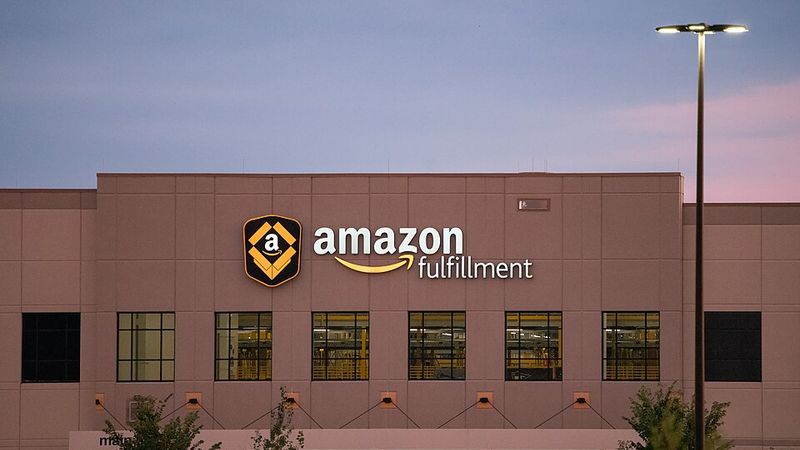
By the end of 1999, Amazon was the poster child of the internet boom — Bezos was Time's Person of the Year and the stock had climbed more than 7,000% from its IPO price. Then the bubble burst. Barron's had already mocked the company as "Amazon.bomb," and analysts began predicting it would run out of cash as its bonds collapsed.
The numbers were brutal: from a peak around $107–113, the stock cratered to about $7 a share, bottoming near $5.67 in September 2001. By autumn 2001 Amazon had lost 94% of its value, and it took more than eight years for the stock to fully recover. The company closed two warehouses and laid off 15% of staff.
What saved Amazon was cash raised just in time — including a large convertible bond offering weeks before the crash — and a real business underneath the hype: customers kept ordering. Amazon posted its first-ever profit in late 2001, proving the model while Pets.com and Webvan died around it. Bezos later called the crash a gift: it wiped out undisciplined competitors and left Amazon alone with the field.
AWS: the profit machine
The decision that made Bezos a centibillionaire was not selling books — it was renting out the computers. Amazon Web Services launched in the spring of 2006 (S3 in March, EC2 in August), productizing the internal infrastructure Amazon had built to survive its own traffic spikes. Netflix moved its infrastructure to AWS in 2010; the rest of corporate America followed.
Today AWS is the engine under the entire fortune. In 2025 it generated $128.7 billion in revenue and $45.6 billion in operating income — roughly a fifth of Amazon's sales but about three-fifths of its operating profit, with margins near 39% against the low-single-digit margins of retail. Every AI workload now running on AWS extends the lead.
AWS turned Amazon from a low-margin retailer into a $2.65 trillion company — and turned Bezos's stubbornly held stake into a $219 billion position. Prime (2005), Kindle (2007), the third-party Marketplace, and the fast-growing ad business all added compounding layers, but none bent the valuation curve like the cloud.
Blue Origin: the quiet $1B-a-year bet (2000)
While the world watched Amazon, Bezos was quietly building rockets. He founded Blue Origin in 2000 — two years before SpaceX existed — and kept it secret for years, developing reusable rockets at a West Texas ranch under the motto Gradatim Ferociter ("step by step, ferociously").
His funding method is the purest expression of how he made his money: convert Amazon winnings into space travel. "I am currently liquidating about $1 billion a year of Amazon stock to fund Blue Origin. And I plan to continue to do that for a long time," he said in 2018, calling it "the most important work that I'm doing". Industry estimates put his total personal investment at $28–30 billion through mid-2026.
For 25 years Blue Origin took no outside money. That changed in 2026 with its first external funding round, reportedly valuing the company at about $130 billion — with Bezos committing another $2 billion himself. Forbes estimates the company is now one of his largest assets after the Amazon stake. He flew to the edge of space aboard New Shepard in July 2021; the orbital New Glenn rocket is the company's bid to catch SpaceX.
Early investments: the $250,000 Google check
Bezos's most famous side bet came in 1998, when Ram Shriram — whose company Junglee had just been acquired by Amazon — introduced him to two Stanford PhD students, Larry Page and Sergey Brin. "I just fell in love with Larry and Sergey," Bezos later said. Though Google's funding round was officially closed, Bezos talked his way in with $250,000 at about four cents a share.
At Google's 2004 IPO his stake equaled 3.3 million shares — a position that would have been worth billions had he held it (roughly $4.8 billion at 2020 prices, a ~20,000% gain). He sold long ago, but the pattern stuck: his personal firm Bezos Expeditions backed early Twitter, Airbnb, and Uber.
His biggest non-Amazon purchase was The Washington Post, bought with $250 million of personal cash in 2013 — deliberately kept separate from Amazon. Philanthropy followed scale: the $2 billion Day One Fund (2018) and a $10 billion climate pledge through the Bezos Earth Fund in 2020, of which about $2.4 billion has been granted. He stepped down as Amazon CEO in 2021 to become executive chairman, freeing his schedule for Blue Origin, the Post, and giving.
Wealth timeline: $245K to $378B
| Year | Net worth | Money event |
|---|---|---|
| 1994 | ~$0 | Founds Amazon; parents invest $245,573 |
| 1995 | — | First sale, July 1995 (garage era) |
| 1997 | ~$0.5B | IPO at $18/share, $438M valuation |
| 1998 | — | $250K angel check into Google |
| 1999–2001 | Crash | Stock falls 94%; first profit, late 2001 |
| 2000 | — | Founds Blue Origin (in secret) |
| 2006 | ~$4B | AWS launches — the profit engine |
| 2013 | ~$25B | Buys Washington Post for $250M cash |
| 2017 | ~$100B | Briefly world's richest person |
| 2019 | ~$115B | Divorce; transfers ~4% of Amazon to MacKenzie Scott |
| 2021 | ~$200B | Steps down as CEO; flies to space |
| 2026 (Sep) | $378B | Forbes 400 #2; Blue Origin valued ~$130B |
The through-line of every row: one concentrated equity position, held for three decades, compounded by a cloud business nobody saw coming in 1994. For the full current breakdown, see our Jeff Bezos net worth guide.
Frequently asked questions
How much of Amazon does Jeff Bezos own?
About 8.8% — roughly 879.3 million shares as of his August 2026 SEC filing, worth ~$219 billion at Amazon's September 2026 share price. He is still Amazon's largest individual shareholder, down from ~16% before his 2019 divorce, when he transferred a quarter of his stake to MacKenzie Scott.
How much did Jeff Bezos's parents invest in Amazon, and what is it worth?
Jackie and Mike Bezos put in $245,573 of their life savings in 1994-95. Held through Amazon's four stock splits, that seed money compounded into one of the great family investments in history — once estimated at tens of billions of dollars at peak valuations.
Does Jeff Bezos take a salary?
Effectively no. As Amazon CEO he drew a famously modest $81,840 base salary for over two decades — his wealth was always equity, never income. Like Musk, he funds spending by selling or borrowing against stock rather than drawing pay.
How much has Jeff Bezos invested in Blue Origin?
About $1 billion a year from Amazon stock sales, a pace he disclosed in 2018 — industry estimates put his total personal investment at $28-30 billion through mid-2026. Blue Origin's first outside funding round in 2026 valued the company at roughly $130 billion.
Is Jeff Bezos the richest person in the world?
No — not anymore. On Forbes' September 2026 ranking of richest Americans he is #2 at $378 billion, behind Elon Musk at $908 billion. Bezos did hold the world's-richest title from 2017 to 2021 before Musk's Tesla and SpaceX valuations pulled ahead.