Quick answer
Liang Wenfeng made his money twice: first in quantitative finance, then in artificial intelligence. He co-founded the hedge fund High-Flyer in 2015, rode it past 100 billion yuan (~$14 billion) in assets, and became a billionaire on fund economics. Then he did something almost no founder does — he funded an AI lab from trading profits instead of venture capital, kept ~84% of it, and watched DeepSeek's ~$50 billion 2026 valuation turn that stake into a $36 billion fortune (Bloomberg, July 2026). See the full net worth breakdown for how the numbers stack up.
The math prodigy from Guangdong
Liang Wenfeng was born in 1985 in Mililing, a village in Wuchuan, Guangdong province. Both parents were primary school teachers, and the household prized education over wealth. Villagers later told the Financial Times he was a "top student" as a child — the kind who read comic books, excelled at math, and reportedly helped classmates with university-level problems while still in high school. The Wall Street Journal described him as a straight-A student throughout.
That talent bought him an early ticket out. At 17, he enrolled at Zhejiang University — one of China's top institutions — in 2002. He earned a bachelor's in electronic information engineering in 2007 and stayed for a master's in information and communication engineering, finishing in 2010 with a thesis on object-tracking algorithms using low-cost PTZ cameras. It was an early signature: doing more with cheaper hardware, the exact philosophy that would later define DeepSeek.
High-Flyer: the quant fund that printed the seed money
After graduating, Liang went into finance — but as an engineer, not a trader. He spent years applying machine-learning methods to quantitative trading, and in June 2015, at age 30, he co-founded High-Flyer (Hangzhou Huanfang Technology), determined to let math and AI pick stocks. The timing was excellent: China's quant industry was taking off, and High-Flyer's models delivered.
By 2021, High-Flyer managed over 100 billion yuan — roughly $14 billion — making it one of China's largest quant funds. Forbes would later note he was "worth at least $1 billion" on the back of it. The standard quant-fund economics did the work: management and performance fees on billions in client assets, plus returns on the partners' own capital. Liang was a billionaire before most of the world had heard his name — the invisible first fortune that made the visible second one possible.
| Year | High-Flyer milestone | Scale |
|---|---|---|
| 2015 | Fund founded (June) | Startup quant shop |
| 2020 | Fire-Flyer I supercomputer online | 1,100 Nvidia A100 GPUs |
| 2021 | Fire-Flyer II completed | ~10,000 Nvidia A100 GPUs |
| 2021 | Peak assets under management | 100B+ yuan (~$14B) |
| 2024 | Flagship product wound down (Feb) | Focus shifts fully to AI |
Regulatory pressure from 2019–2023 squeezed the fund, and in February 2024 High-Flyer shut its primary investment product. By then, Liang's attention — and his capital — had already moved on. Our companies guide details how the two entities relate.
The GPU stockpile: a bet nobody understood
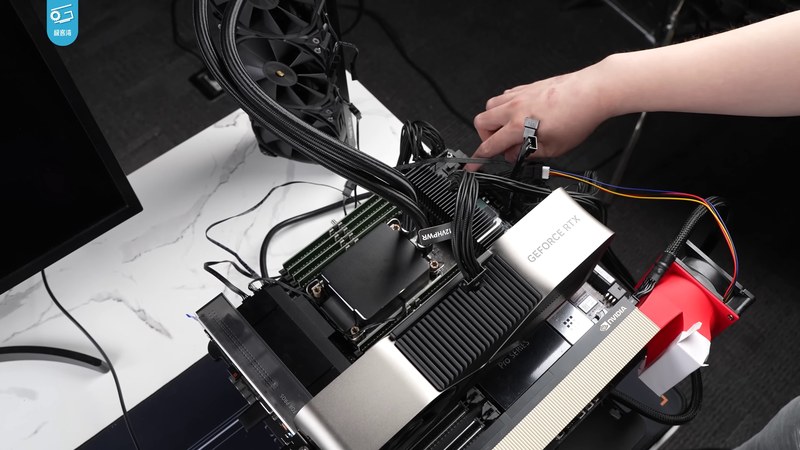
Here is the move that separates Liang from every other quant manager. Starting around 2021, he began buying Nvidia graphics processors by the thousand — before the US restricted advanced-chip exports to China. A business partner later told the Financial Times that when Liang talked about building a 10,000-chip cluster to train his own AI models, "we didn't take him seriously... We thought this was only possible from giants like ByteDance and Alibaba."
He built it anyway: Fire-Flyer I (1,100 A100s) in 2020, then Fire-Flyer II (~10,000 A100s) in 2021. Officially it was for trading research; in practice it was an AI supercomputer wearing a hedge fund's clothes. When export controls arrived, the stockpile became a strategic moat no competitor could easily replicate — the sunk-cost foundation that let DeepSeek train frontier models at a fraction of rivals' spending.
Founding DeepSeek: the side project becomes the company
In July 2023, Liang formally spun the AI effort out as DeepSeek, headquartered in Hangzhou with the stated mission of pursuing artificial general intelligence. In a 2023 interview with Chinese tech publication 36Kr, he was strikingly candid about the economics: "Basic science research has a very low return on investment. But we're doing this because we believe in the mission."
The structure was the masterstroke. Because High-Flyer funded everything, DeepSeek took no outside investment — no venture rounds, no dilution. Liang kept an estimated ~84%. He also staffed it unconventionally: mostly young graduates from elite Chinese universities (Peking University, Tsinghua) rather than expensive Big Tech veterans, betting that curiosity beats résumés. It was a research lab with a hedge fund's balance sheet and a startup's hunger.
Why the self-funding model worked
Three structural advantages made Liang's approach unbeatable. First, time horizon: venture-backed labs answer to investors who want returns in 7–10 years; Liang answered to himself, so he could fund "basic science research" with "very low return on investment" — his own words to 36Kr — for years before R1 ever shipped. Second, talent arbitrage: while US labs paid millions to poach senior researchers, DeepSeek hired hungry young graduates from Peking University and Tsinghua at a fraction of the cost, betting curiosity outperforms credentials.
Third, constraint as strategy: US export controls on advanced chips, meant to slow China, forced DeepSeek into the efficiency innovations — mixture-of-experts architectures, multi-token prediction — that became its competitive edge. Rivals threw money at the problem; Liang's team had to throw ingenuity. The irony markets priced in during January 2025: scarcity produced the breakthrough abundance couldn't. That dynamic is also why, in a head-to-head wealth comparison with Dario Amodei's venture-backed path, the self-funded founder ended up richer.
The R1 moment: when the world noticed
DeepSeek-V3 landed in December 2024; then, on January 20, 2025, DeepSeek-R1 — a reasoning model matching GPT-4-class performance — shot to the top of app stores worldwide. The claimed training cost of under $6 million (versus ~$100 million for comparable Western efforts) detonated across markets: Nvidia shares plunged ~17%, erasing roughly $600 billion in market value in a single session, as investors questioned whether the industry's hundreds of billions in AI capex were necessary.
The day after the release, Liang was summoned to a symposium with Premier Li Qiang — Beijing's signal that it considered him a strategic asset. Time named him to its 100 most influential people in AI; Fortune put him on its most powerful people in business list. The village hero's welcome he received in Guangdong for Lunar New Year 2025 — red banner and all — was the folk version of the same story.
The $50 billion round: paper becomes fortune
Fame compounded into valuation through 2025 and 2026. DeepSeek's models kept shipping — V4 arrived in April 2026 with a 1.6-trillion-parameter Pro variant — while the long-awaited R2 reasoning model was reportedly held back by Liang himself over quality concerns. Then came the June 2026 financing round, valuing DeepSeek's technology assets at roughly $50 billion post-money.
That single round repriced everything. Bloomberg's index marked Liang's fortune up from ~$16.7 billion to $36 billion — a $19.9 billion jump, +120% year-to-date — and named him the world's richest founder of an AI-model company, ahead of Dario Amodei and OpenAI's Greg Brockman. Two fortunes, one playbook: make money with machines, then use the machines to make the money irrelevant. For how that wealth translates into day-to-day income, see his salary and pay breakdown.
Frequently asked questions
How did Liang Wenfeng make his money?
In two stages. First, quantitative finance: he co-founded the hedge fund High-Flyer in 2015, growing it past 100 billion yuan (~$14 billion) in assets by 2021 and becoming a billionaire on fund economics. Second, artificial intelligence: he founded DeepSeek in 2023 using High-Flyer profits, kept ~84% of the company by refusing venture capital, and rode it to a ~$50 billion valuation in 2026 — worth $36 billion on Bloomberg's math.
When did Liang Wenfeng become a billionaire?
During the High-Flyer years. Forbes noted he was 'worth at least $1 billion' after the quant fund he co-founded in 2015 scaled past 100 billion yuan in assets under management by 2021. The DeepSeek era then multiplied that fortune roughly thirty-fold on paper.
What is High-Flyer and how did it make money?
High-Flyer (Hangzhou Huanfang Technology) is a quantitative hedge fund Liang co-founded in June 2015 that uses machine-learning models to trade Chinese equities. Like most quant funds it earns money from management and performance fees on client assets plus returns on partners' own capital — and at over 100 billion yuan in peak assets, those economics made its founders very rich.
How much did it cost to build DeepSeek?
Far less than Western rivals. DeepSeek claimed its V3 model cost under $6 million in training compute — versus the ~$100 million figures cited for comparable Western models — by using engineering tricks like mixture-of-experts architecture. The catch: that figure excludes the ~10,000 Nvidia GPUs High-Flyer had already stockpiled, reportedly worth hundreds of millions, which made the cheap training possible.
Why didn't Liang Wenfeng take venture capital for DeepSeek?
He didn't need to. High-Flyer's trading profits funded the AI research directly, so he kept roughly 84% ownership instead of diluting to VCs — the decision that ultimately made him the world's richest AI founder. He has described the motivation as mission-driven: pursuing artificial general intelligence as basic research, not as a venture-scale business plan.
Is Liang Wenfeng married?
No credible source has confirmed it. Liang keeps his personal life entirely private — profiles in the Wall Street Journal, Financial Times, and New York Times cover his work, never his family. Treat gossip-site claims about a wife or children as unverified; there is no public record.
How old is Liang Wenfeng in 2026?
Born in 1985 in Wuchuan, Guangdong, he is 41 in 2026. He entered Zhejiang University at 17, earned his master's in 2010, and co-founded High-Flyer at 30 — a compressed timeline even by tech-founder standards.
Where does Liang Wenfeng live?
Hangzhou, China, where he runs both High-Flyer and DeepSeek. He grew up in Mililing village in Guangdong — where he received a hero's welcome during Lunar New Year 2025 — but his business life is anchored in Hangzhou's tech corridor.
Sources
- Bloomberg Billionaires IndexBloomberg
- Reuters — DeepSeek CoverageReuters
- Forbes Real-Time BillionairesForbes